How Long Does It Take to Build a Website? A Realistic 2026 Timeline for Small Businesses
You’ve decided your business needs a new website. Maybe your old one looks dated, maybe you’ve never had one, or maybe a competitor just launched something slick and your phone has gone quiet. The next question is always the same: how long is this going to take?
The honest answer is “it depends,” but that’s not much help when you’re planning a launch, a busy season or an ad campaign. So this guide gives you real numbers. You’ll see typical timelines by type of site, a week-by-week breakdown of a small business build, the five things that cause most delays, and what you can do to get your site live faster.
The quick answer
Most small business websites take about 2 to 6 weeks to build. A simple 5-page site with your content ready can go live in around two weeks. Larger sites, online stores and custom builds take months.
Industry estimates line up with that range. Ramotion puts a multi-page small business site at around 4 to 6 weeks and a single landing page at 1 to 2 weeks. Inbound281 says a simple website takes 1 to 3 weeks, while a larger corporate site can take 4 to 16 weeks.
The biggest variable usually isn’t the design or the code. It’s how quickly the content, feedback and decisions arrive from your side. We’ll come back to that.
| Type of website | Typical build time | Good fit for |
|---|---|---|
| Single landing page | 1 to 2 weeks | One offer, one ad campaign, one event |
| Small business site (around 5 pages) | 2 to 6 weeks | Local service businesses, contractors, consultants, restaurants |
| Larger business site (10 to 30 pages) | 4 to 16 weeks | Multi-location or multi-service businesses |
| Online store | 2 to 3 months or more | Selling products online with payments and inventory |
| Complex custom website or web app | 6 months or more | Booking platforms, portals, custom features |
Ranges compiled from Ramotion and Inbound281. Your project may be faster or slower.
What happens during a website build, week by week
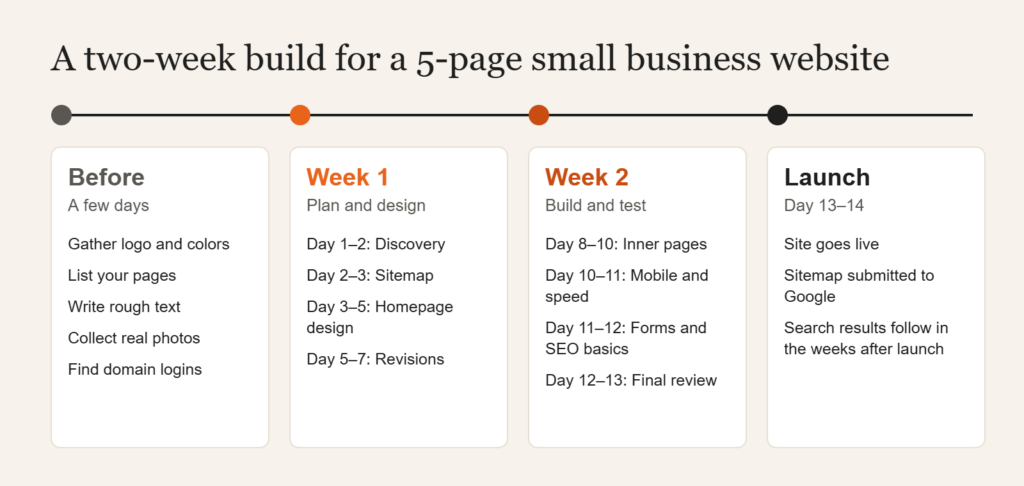
Here’s what a typical 5-page small business website looks like from first call to launch, when the business owner has most of their content ready. Every designer works a little differently, but the stages are almost always the same.
Before the build: preparation (a few days)
This is the stage most people skip, and it’s the one that saves the most time. Before any design work starts, gather:
- Your logo and brand colors (or a note saying you need them)
- A list of the pages you want, usually Home, About, Services, Reviews/Gallery and Contact
- Text for each page, even rough bullet points
- Real photos of your team, your work and your premises
- Login details for your domain name and any existing hosting
- Two or three websites you like, and what you like about them
Our website preparation checklist walks through each item in detail.
Week 1: planning and design
- Discovery (day 1 to 2). Your designer learns what you sell, who your customers are, which areas you serve and what you want visitors to do: call, book or request a quote.
- Sitemap and structure (day 2 to 3). The pages and the order of sections on each page are agreed. This is where a local business plans its service pages and service-area content.
- Homepage design (day 3 to 5). A design of the homepage is created first, because it sets the style for every other page. You review it and ask for changes.
- Revisions (day 5 to 7). Feedback rounds happen here. Quick, specific feedback keeps this to a day or two; slow or vague feedback can stretch it to weeks.
Week 2: build, test and launch
- Inner pages built (day 8 to 10). The approved style is applied to the remaining pages, and your text and photos go in.
- Mobile and speed checks (day 10 to 11). Every page is checked on phones, tablets and desktops. Images are compressed so the site loads quickly.
- Forms, tracking and SEO basics (day 11 to 12). Contact forms are tested, page titles and meta descriptions are written, and analytics is connected.
- Final review (day 12 to 13). You click through the whole site and sign off.
- Launch (day 13 to 14). The site goes live on your domain, and an XML sitemap is submitted to Google Search Console.
That’s how a two-week build works. It’s realistic for a small, focused site, and it’s the timeline we work to at Crazy Media Design: a 5-page website from $750, delivered in about two weeks, with unlimited revisions.
After launch: the first few weeks
Going live isn’t quite the finish line. A few things run on their own clocks after launch:
- DNS changes. When your domain is pointed at new hosting, most updates finish within a few hours, but GoDaddy advises allowing up to 48 hours for full propagation.
- Google indexing. Google says crawling can take anywhere from a few days to a few weeks, and requesting the same URL again won’t make it happen faster. Submitting a sitemap is the recommended way to tell Google about many pages at once.
- Google Business Profile. If you’re also setting up or updating your profile, Google says verification reviews take up to 5 business days, and postcard codes usually arrive within 14 days.
So while your site can be live in two weeks, give it a few more weeks before judging how it performs in search.
5 things that slow a website build down
When a “two-week website” turns into a two-month website, it’s rarely because the design was hard. These are the usual culprits.
1. Content isn’t ready
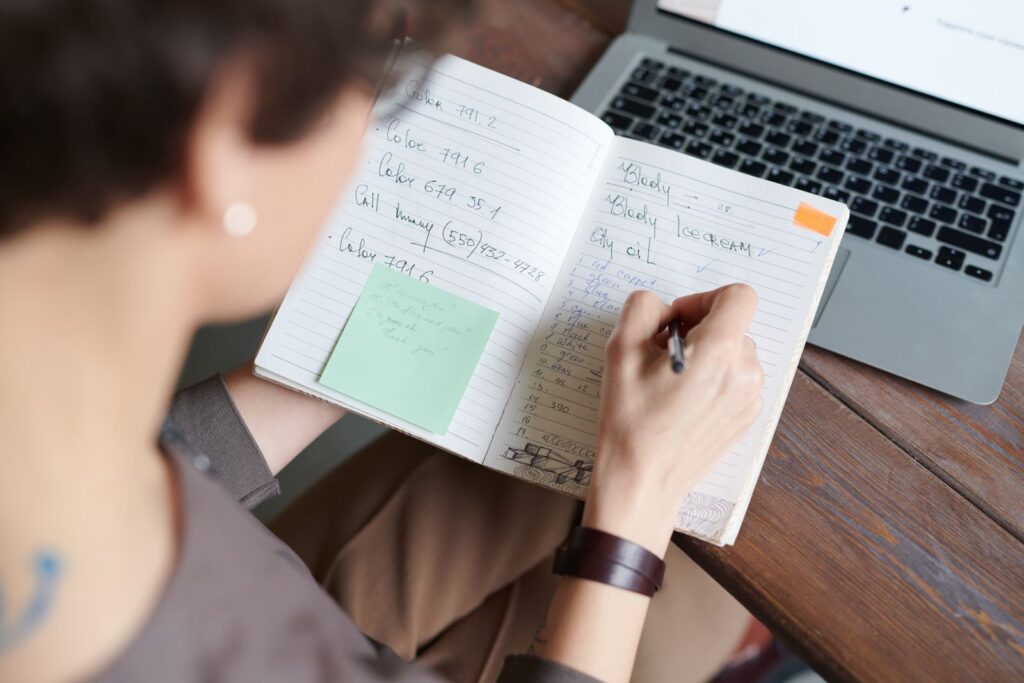
This is the number one cause of delays. Designers can build page layouts quickly, but they can’t write your service descriptions, pricing notes or “About us” story without you. If the text and photos arrive in week three, launch moves to week four or five. Even rough notes help: a good designer can shape bullet points into page copy, but they need to know what you actually do.
2. Too many decision-makers
If a business partner, spouse, office manager and nephew all need to approve the design, every round of feedback takes longer. Agree who has the final say before the project starts, and send feedback as one combined list.
3. Scope creep
“While we’re at it, can we add online booking?” Adding pages, booking systems, payment forms or a blog halfway through resets parts of the timeline. Write down everything you might want at the start, then decide what goes in version one and what comes later.
4. Vague feedback
“I don’t love it” is hard to act on. “Make the header photo show our crew, and move the phone number higher” can be fixed the same day. Specific feedback is the fastest kind.
5. Missing logins
It’s surprisingly common for a launch to stall because no one remembers who registered the domain name or which email has the hosting login. Track these down in week one, not on launch day.
How to get your website built faster
You have more control over the timeline than you might think. To keep your build on track:
- Start with a clear goal. Know what you want visitors to do: call, book, fill in a form or visit your store.
- Keep version one small. A focused 5-page site that launches this month beats a 25-page site that launches next year. You can add pages later.
- Prepare content first. Use a website preparation checklist before the kickoff call.
- Reply to feedback requests within 24 to 48 hours. Each day you wait usually adds a day to launch.
- Choose a designer with a set process. Ask for a timeline in writing, the number of revision rounds, and what they need from you and when.
- Use real photos. They’re faster to source than you’d think. A phone and good daylight beat stock photos for most local businesses.
Does a faster website mean a worse website?
Not necessarily. Speed comes from process, not shortcuts. A small business website built in two weeks can be fast, mobile-friendly and optimized for local search, as long as the scope is clear and the content is ready.
Where you should be wary is the “website in a day” pitch. A rushed site often skips the parts that bring in customers: clear calls to action, page titles and meta descriptions, location and service pages, and mobile testing. If you want to see what a well-planned local site includes, read our guide to local business website design or small business website design.
Time and budget usually move together, too. Larger sites with more pages and features cost more because they take longer. Our website cost guide breaks down what affects price, and if you’re replacing an existing site, see how much a website redesign costs.
What happens after your website is live
A website isn’t a one-time project. Once it’s live, it needs regular software and plugin updates, security monitoring, backups and small content changes, like new photos, updated hours or a new service. Plan for this from day one so your new site stays fast and secure. Our website maintenance plans cover the routine work so you can focus on running your business.
Frequently asked questions
How long does it take to build a website for a small business?
Most small business websites take about 2 to 6 weeks. A focused 5-page site can launch in around two weeks when your text, photos and logins are ready at the start.
How long does it take to make a website with a website builder?
DIY builders let you publish quickly, but you do all the writing, design and setup yourself. Most owners fit this around running their business, so it often stretches over several weeks of evenings and weekends.
What is a typical website design timeline?
A typical small business timeline runs: preparation (a few days), discovery and sitemap (1 to 3 days), homepage design and revisions (about a week), inner pages, testing and launch (about a week).
How long does it take for a new website to show up on Google?
Google says crawling can take from a few days to a few weeks. Submitting a sitemap in Google Search Console helps Google find your pages, but requesting indexing repeatedly won’t speed it up.
How long does an online store take to build?
Online stores usually take 2 to 3 months or more, because products, payments, shipping and inventory all need to be set up and tested.
What can I do to speed up my website build?
Have your content and photos ready before kickoff, agree on one decision-maker, keep version one to the pages you need now, and reply to feedback requests within a day or two.
See your new homepage before you commit
Wondering what your business could look like online in two weeks? We’ll design your new homepage for free, based on your business, your services and your customers. If you like it, we’ll build the full site: a 5-page website from $750, delivered in about two weeks, with unlimited revisions.
No obligation. Don’t love it? You don’t pay a thing.
Sources
- Ask Google to recrawl your URLs, Google Search Central
- Verify your business on Google, Google Business Profile Help
- What factors affect DNS propagation time?, GoDaddy Help
- How long does it take to develop a website?, Ramotion
- How long does it take to design a website, Inbound281
Need a website that brings in inquiries?
Get a professional website, live in two weeks
We build fast, mobile-friendly websites for local businesses, planned around what you need your website to do. Five pages from $750, with unlimited revisions until you approve.

You’ll talk directly with Govind,
founder of Crazy Media Design.
$750
Five-page website · starting price
- Delivered in two weeks
- Unlimited revisions
- Mobile-friendly and fast
- You own your website