
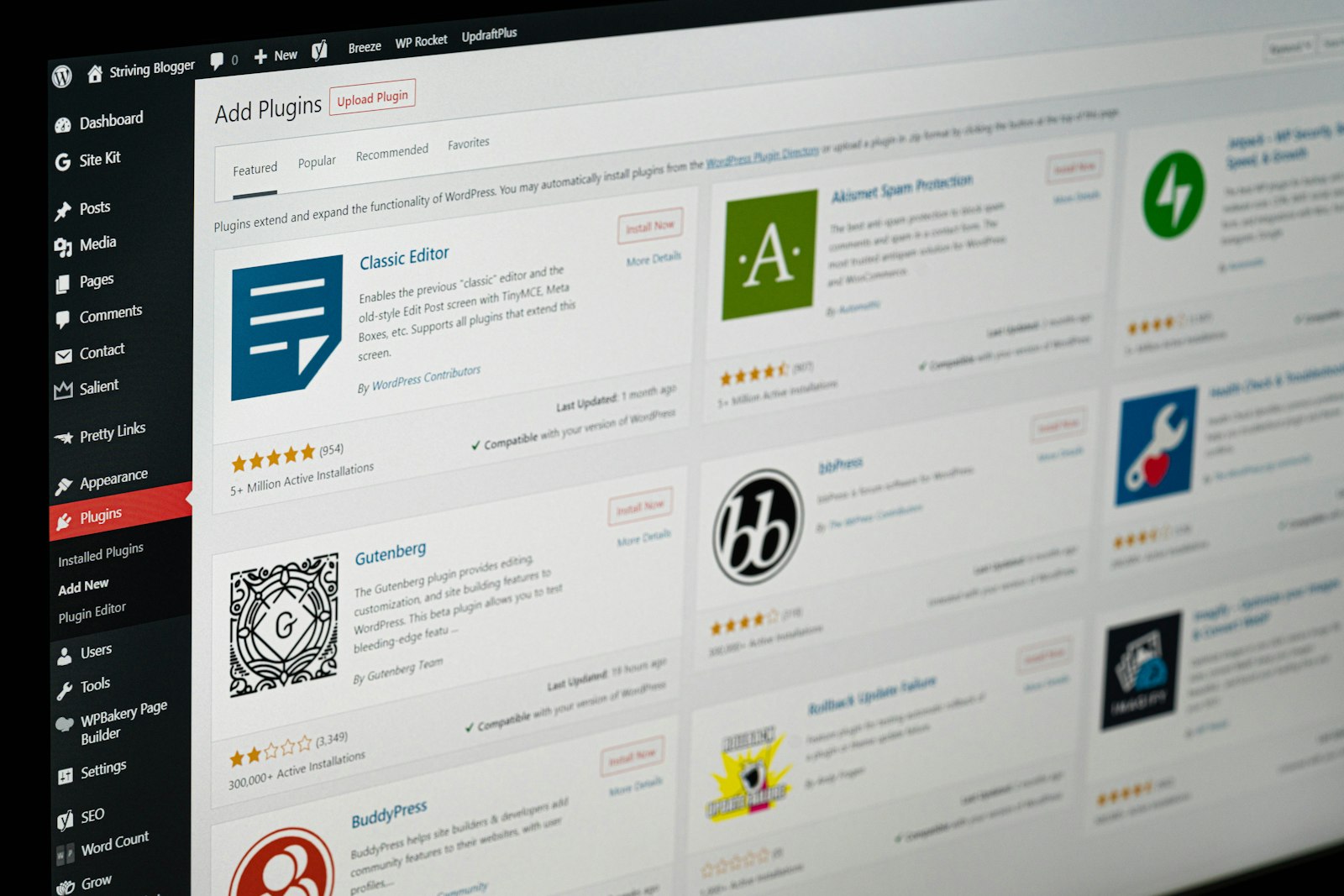
Best WordPress Plugins for Small Business Websites: The Lean Stack
A small business WordPress website needs about six to eight plugins: one each for SEO, backups, security, caching and speed, forms, spam protection and analytics, plus a cookie consent tool if you need one. Most of these have excellent free versions. More plugins rarely make a site better; they make it slower and give attackers more ways in.
That last point matters more than most plugin lists admit. Patchstack’s State of WordPress Security in 2026 report found that plugins account for about 96% to 97% of all WordPress vulnerabilities, and roughly 46% of reported vulnerabilities had no developer patch before they were disclosed publicly. Every plugin you add is code you are trusting with your website.
This guide gives you a lean plugin stack by job, what each one does, what’s free and what’s worth paying for, and how to judge any plugin before you install it. Where we can, we name the plugins we run on this very website.
The lean plugin stack for a small business website
| Job | What we use or recommend | Free version enough? | Watch out for |
|---|---|---|---|
| SEO | Rank Math (used on this site) | Yes, for most small businesses | Don’t run two SEO plugins at once |
| Backups | UpdraftPlus (used on this site) | Yes, if you send backups off the server | Backups stored only on the same server don’t help when the server fails |
| Speed and caching | LiteSpeed Cache on LiteSpeed hosting (used on this site); otherwise your host’s recommended cache plugin | Yes | LiteSpeed’s page cache only works on a LiteSpeed server |
| Security | Wordfence or Solid Security | Mostly; see below | Wordfence free firewall rules arrive 30 days after premium |
| Contact forms | One reputable form plugin | Yes, for simple forms | Test that form emails actually arrive |
| Spam protection | A honeypot plugin such as WP Armour (used on this site) | Yes | Visible CAPTCHAs can cost you genuine inquiries |
| Analytics | Site Kit by Google, or a tag added by your theme | Yes | One tracking method only, or you’ll double-count visits |
| Cookie consent | A consent tool, if your visitors or laws require it (this site uses Axeptio) | Depends on traffic and features | Requirements depend on where your visitors are; check your own obligations |
Your theme and page builder are separate decisions. This site runs on the Kadence theme with Kadence Blocks; any well-maintained, lightweight theme is fine.
SEO: Rank Math
An SEO plugin lets you set the title and description Google shows for each page, creates your XML sitemap and adds structured data. Rank Math’s free version, used on more than 4 million sites, includes XML sitemaps, 16+ schema types, a redirection manager and a 404 monitor. That covers almost everything a local business site needs.
Yoast SEO and All in One SEO do the same core job. Pick one and stick with it; running two SEO plugins produces duplicate tags and conflicting sitemaps.
Backups: UpdraftPlus
Backups are the plugin you hope never to need. UpdraftPlus (3+ million installs) can schedule automatic backups every few hours, daily, weekly or monthly in its free version, and send them to Dropbox, Google Drive, Amazon S3 and other remote storage.
The important part is remote. A backup stored on the same server as your website is lost if the server is. Paid features such as incremental backups, automatic backups before updates and easier migration are useful but not essential for a small site.
Also check whether your host takes its own daily backups. Two independent backups are better than one.
Speed and caching
A caching plugin stores ready-made copies of your pages so they load faster. Which one to use depends on your hosting. LiteSpeed Cache (7+ million installs) is excellent and free, but its page caching only works on LiteSpeed servers; its image optimisation, minification and lazy-loading features work anywhere.
If your host doesn’t run LiteSpeed, use the caching tool your host recommends. Many managed WordPress hosts include caching at server level and ask you not to install another cache plugin. Two caching plugins at once is a common cause of broken layouts.
Security: Wordfence or Solid Security
A security plugin adds a firewall, malware scanning, login protection and two-factor authentication. Wordfence (5+ million installs) includes a firewall and malware scanner in its free version, but free users receive new firewall rules and malware signatures 30 days after premium users. For a business site that handles customer details, that delay is worth weighing.
A security plugin is the last line of defence, not the first. The first lines are keeping everything updated, strong unique passwords, two-factor authentication for every admin, and fewer plugins.
Forms and spam protection
Every business site needs at least one working contact form, and that form will attract spam. Use one reputable form plugin for all your forms, and a honeypot plugin to block bots invisibly. Honeypots catch most automated spam without making real customers solve a puzzle.
After installing any form plugin, send yourself a test inquiry and check it arrives. Form emails landing in spam, or not arriving at all, is one of the most common reasons a small business website “isn’t getting inquiries”. Our article on why your website isn’t getting inquiries covers the other common causes.
Analytics
You need to know which pages bring visitors and inquiries. Site Kit by Google connects Google Analytics and Search Console to your WordPress dashboard. Alternatively, your theme or SEO plugin can add the Analytics tag. Use one method, not both.
How to judge any plugin before you install it
Before adding a plugin, check its page on WordPress.org:
- Last updated. Updated within the last few months is good. Not updated for a year or more is a warning sign.
- Tested with your WordPress version. Shown on the plugin page.
- Active installations. Widely used plugins tend to have problems found and fixed faster.
- Support forum. Are questions answered? Are recent threads full of the same unresolved problem?
- Ratings. Read the recent one-star reviews, not just the average.
- Does it overlap with something you already have? Two plugins doing the same job cause conflicts.
- Can you do without it? A small layout tweak or a single snippet often doesn’t need a whole plugin.
Plugins most small business sites don’t need
- Sliders. Heavy, slow and rarely clicked. We explain why in reasons you don’t need a slider.
- Several page builders. Pick one and use it everywhere.
- Social share counters on a local service site.
- “All-in-one” bundles that add dozens of features you’ll never use.
- Plugins from outside WordPress.org or the developer’s official site. “Free” copies of premium plugins are a common way malware gets onto sites.
A simple monthly plugin maintenance routine
- Check that last night’s backup completed and is stored remotely.
- Update WordPress core, your theme and plugins, one at a time on important sites.
- Load the homepage, a service page and the contact page, and submit a test form.
- Delete any plugin you’ve deactivated and don’t plan to use. Deactivated plugins can still be a security risk.
- Review admin users and remove anyone who no longer needs access.
That’s about 30 minutes a month for a small site. If you’d rather not do it yourself, budget for a maintenance plan; see how much a website costs for ongoing costs.
Frequently asked questions
How many plugins is too many?
There’s no fixed number. One badly coded plugin can slow a site more than ten good ones. For a small business site, six to ten well-maintained plugins is typical; if you’re above 20, review whether each one still earns its place.
Are free plugins safe?
Free plugins from WordPress.org with regular updates and large user bases are generally safe, and many are excellent. The risk comes from abandoned plugins, pirated premium plugins and anything left un-updated.
Which plugins does every WordPress site need?
At minimum: an SEO plugin, a backup plugin that stores copies off the server, and a way to protect logins. Most business sites also need a contact form and spam protection.
Do I need a security plugin if my host has security?
Many hosts include a firewall and malware scanning. A security plugin adds login protection and two-factor authentication inside WordPress. Ask your host what they cover before doubling up.
Want a WordPress site built lean from day one?
Every website we build ships with a small, well-maintained plugin set: SEO, backups, security, speed and forms, configured and tested. Book a free call to talk about yours.
Sources
- Web60: WordPress plugin vulnerabilities in 2026, summarising Patchstack’s State of WordPress Security in 2026 report
- Rank Math on WordPress.org
- UpdraftPlus on WordPress.org
- LiteSpeed Cache on WordPress.org
- Wordfence on WordPress.org
Need a website that brings in inquiries?
Get a professional website, live in two weeks
We build fast, mobile-friendly websites for local businesses, planned around what you need your website to do. Five pages from $750, with unlimited revisions until you approve.

You’ll talk directly with Govind,
founder of Crazy Media Design.
$750
Five-page website · starting price
- Delivered in two weeks
- Unlimited revisions
- Mobile-friendly and fast
- You own your website